The Tale of the Stubborn Fish
Updated: Mar 15

Above is the notorious fish (Aphyosemion elegans) that seems to be trying really hard to mask its genetic identity from us—I would ask him why, but unfortunately all we have of him is dead pieces of tissue. All the other fish had ended up working pretty decently, so what was different about this one? I didn’t have an answer and neither did my mentor. The only thing left to do was to try and experiment with different temperatures and solutions to hopefully land on exactly what this fish needed.
Knowing how much work and resources it takes to run one PCR,—refer to blog #6 for more info—I was a little confused as to how we would be able to try different temperatures in an efficient manner. This was when my mentor introduced me to an awesome invention that the museum happened to have: Gradient PCR! Normally, all the tubes put into a PCR machine are subject to the same set of temperatures throughout the process of denaturation (DNA separation at ~95°C), annealing (primer binding at ~50–60°C), and extension (DNA synthesis at ~72°C). This is how we had been conducting the PCR. Now, Gradient PCR would allow us to use a series of temperatures over a certain range for each step, hence the name. This feature would allow each row of tubes in the machine to be subject to a slightly different temperature for each step, hence the name gradient.
This would mean a little bit more work: instead of just one, each specimen would need to have five solutions containing the PCR mix, which consisted of a chosen reverse and forward primer, the DNA polymerase for binding, enough A, T, C, and G nucleotides for synthesis, and the DNA from our fish tissue. Each solution would be in a different row in the machine and tested with a different temperature. We did this with four different specimens of Aphyosemian Elegans. This whole process was also done twice as, in addition to changing the temperature, we decided to use it with three different primers, two from before and one that had just been delivered to the museum (F1R1, HCO LCO and F2R2).
After spending time preparing these mixtures and doing PCR, it was finally time to run a gel to see what would work. The forty minutes I sat there talking to my mentor about what to get his wife for Valentine's day while we waited for the gel might have been the longest forty minutes of my life. As we debated between chocolate and flowers or a nice dinner, the timer rang and I jumped from my seat to unplug the machine. Quickly, we moved the gels under UV light one by one, and I assured myself that no matter what happened, it would eventually work out. Photos of our results are below.


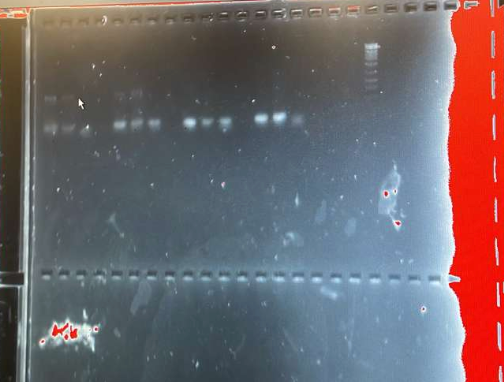
Top to bottom: Gel with primer HCO LCO, gel with primer F2R2, and gel with primer F1R1.
As you can see, thankfully, one of the primers worked! It was one that we had tried before however at a higher temperature. It was a good thing that we decided to try it again as it turned out that the lower temperatures worked a lot better, specifically around 43°C. We didn’t know exactly why, but now we knew that somehow this little bright orange fish’s DNA liked 43° as opposed to 47°, and that the F1R1 primer was its favorite. This fish could now join all of his friends in the lab for Sanger Sequencing and stop feeling like the little outsider he was.
This work highlighted to me how sensitive this process is; the difference between no bars on a Gel to big, bright white lines could be a matter of degrees. It makes me proud to know that if someone else decides to sequence Aphyosemian Elegans in the future, our efforts will have saved them time trying various settings and temperatures. Research is built on trial and error. If we could solve every problem in a day’s work at the lab, nobody would learn how to be flexible and take different approaches in face of challenges.


Comments